 Image 1 of 1
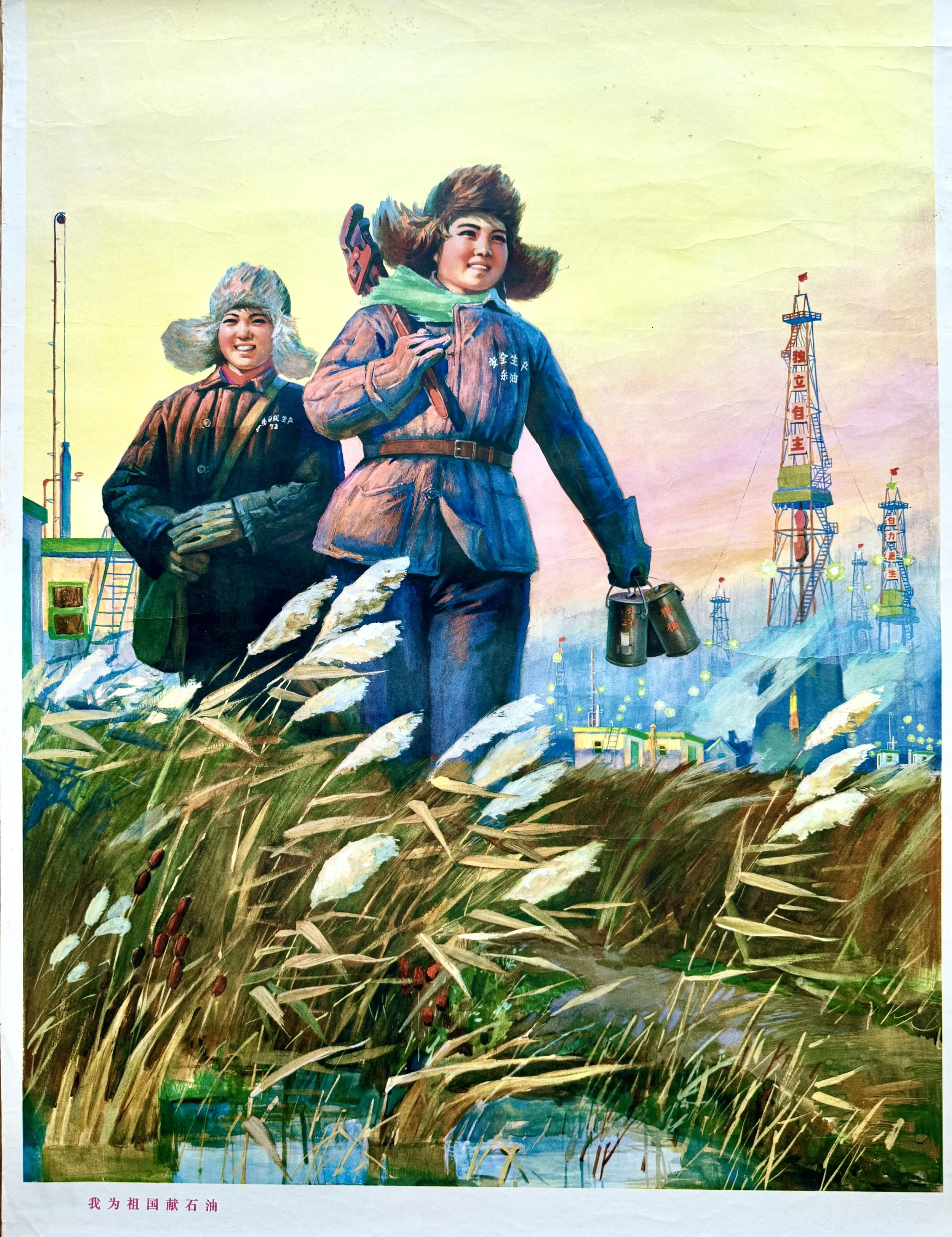
I Dedicate My Oil to the Motherland
Socialist realism is an artistic style that developed in the Soviet Union following the Bolshevik Revolution. Encompassing the visual arts, literature, and theatre, it became the official form of artistic expression in the USSR and aligned socialist countries from the 1930s through the 1980s. The term Socialist Realism was first used at the 1934 Soviet Writer's Congress. The basic rules were simple: The work must be proletarian, relevant to the lives of workers, and easily understandable. It must be typical, involving everyday scenes from life on the farm, in factories, mines, etc. It must be realistic, in the representational sense (though usually highly-idealized). And it is of course always partisan, reinforcing the ideals and goals of the State and Party.
Socialist realism flowered in China under Mao Zedong during the years 1949-1976. Early in the Revolutionary period, simple graphic posters (often woodblock prints) were the primary means of disseminating information and exhortations. In 1955, during a period of friendly relations with the Soviet Union, the Soviet painter Konstantin Mefodovich Maksimov (b. 1913) was appointed to Beijing’s Central Academy of Fine Arts. He brought with him the concepts of Soviet-style socialist realism, along with an operatic painting style that captured Mao's imagination. Following the Sino-Soviet split in 1958, Chinese socialist realism evolved into what can be called Revolutionary Realism, with its own set of principles and conventions. For example, the idea of the "three prominences" (三突出原則), in which three especially virtuous figures are highlighted in a crowd scene (sometimes all three figures are depicted heroically, but often one figure stands out as the central protagonist). Another trope is the principle of "red, bright, and luminescent" (紅光亮原則), in which the worker-hero is depicted as preternaturally, strong, healthy, and beautiful— literally radiant.
In the West, Chinese socialist realism is universally-referred to as propadanda, e.g., "Chinese propaganda posters." This term carries some unfortunate pejorative associations, implying an intent to deceive. We prefer the Chinese expression xuānchuán (宣传), which esentially means "disseminating information." The term xuān orignally referred to the imperial houses, but can be more broadly understood as the state. Chuán means transmission, delivery, broadcasting. So, xuānchuán can be understood as the transmission of information from the authorities, to educate and inspire the populace. In the early decades of the Revolution, in an environment of limited literacy and minimal media, posters played a central role. They also had an inspirational function of course, encouraging and reassuring the proletariat that they were an important part of important and challenging undertakings, from the Great Leap Forward to the Cultural Revolution. Thus, the heroic staging of the compositions and the relentlessly cheerful demeanor of the characters. This is why Chinese socialist realism is sometimes called “revolutionary romanticism."
The end of the Cultural Revolution, and the reopening of China to the West in 1978 marked the fall of Revolutionary Realism. Our posters were collected by our friend Tim in China in the 1980s. We have dozens, covering a variety of subjects from agriculture to athletics. Please inquire if interested!
The fine print: "I Dedicate My Oil to the Motherland. By Zhang Hongzan. Native of Liaoning. Published by Kaishe Publishing. Distributed by Liaoning Province Xiaojiwu. First Edition: October 1973. First Printing: October 1973 . 1–200,000 Copies. Printed by the Jinzhou Printing Factory."
Socialist realism is an artistic style that developed in the Soviet Union following the Bolshevik Revolution. Encompassing the visual arts, literature, and theatre, it became the official form of artistic expression in the USSR and aligned socialist countries from the 1930s through the 1980s. The term Socialist Realism was first used at the 1934 Soviet Writer's Congress. The basic rules were simple: The work must be proletarian, relevant to the lives of workers, and easily understandable. It must be typical, involving everyday scenes from life on the farm, in factories, mines, etc. It must be realistic, in the representational sense (though usually highly-idealized). And it is of course always partisan, reinforcing the ideals and goals of the State and Party.
Socialist realism flowered in China under Mao Zedong during the years 1949-1976. Early in the Revolutionary period, simple graphic posters (often woodblock prints) were the primary means of disseminating information and exhortations. In 1955, during a period of friendly relations with the Soviet Union, the Soviet painter Konstantin Mefodovich Maksimov (b. 1913) was appointed to Beijing’s Central Academy of Fine Arts. He brought with him the concepts of Soviet-style socialist realism, along with an operatic painting style that captured Mao's imagination. Following the Sino-Soviet split in 1958, Chinese socialist realism evolved into what can be called Revolutionary Realism, with its own set of principles and conventions. For example, the idea of the "three prominences" (三突出原則), in which three especially virtuous figures are highlighted in a crowd scene (sometimes all three figures are depicted heroically, but often one figure stands out as the central protagonist). Another trope is the principle of "red, bright, and luminescent" (紅光亮原則), in which the worker-hero is depicted as preternaturally, strong, healthy, and beautiful— literally radiant.
In the West, Chinese socialist realism is universally-referred to as propadanda, e.g., "Chinese propaganda posters." This term carries some unfortunate pejorative associations, implying an intent to deceive. We prefer the Chinese expression xuānchuán (宣传), which esentially means "disseminating information." The term xuān orignally referred to the imperial houses, but can be more broadly understood as the state. Chuán means transmission, delivery, broadcasting. So, xuānchuán can be understood as the transmission of information from the authorities, to educate and inspire the populace. In the early decades of the Revolution, in an environment of limited literacy and minimal media, posters played a central role. They also had an inspirational function of course, encouraging and reassuring the proletariat that they were an important part of important and challenging undertakings, from the Great Leap Forward to the Cultural Revolution. Thus, the heroic staging of the compositions and the relentlessly cheerful demeanor of the characters. This is why Chinese socialist realism is sometimes called “revolutionary romanticism."
The end of the Cultural Revolution, and the reopening of China to the West in 1978 marked the fall of Revolutionary Realism. Our posters were collected by our friend Tim in China in the 1980s. We have dozens, covering a variety of subjects from agriculture to athletics. Please inquire if interested!
The fine print: "I Dedicate My Oil to the Motherland. By Zhang Hongzan. Native of Liaoning. Published by Kaishe Publishing. Distributed by Liaoning Province Xiaojiwu. First Edition: October 1973. First Printing: October 1973 . 1–200,000 Copies. Printed by the Jinzhou Printing Factory."